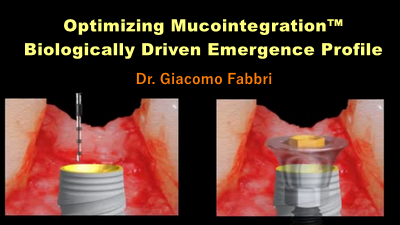
A prosthetic treatment plan must allow for the integration of esthetic, biological and functional requirements for natural teeth and implants. In the case of implants, the prosthetic treatment is usually more challenging due to inevitable soft tissue changes after tooth extraction. In this sense the surgical and prosthetic approach play an essential role in optimizing prosthetic integration and simultaneously achieving reliable and stable prosthetic results. Nowadays, it is well known that biological integration and stability around implants, can be significantly influenced by the correct use of modern implant and prosthetic components. Implantology has reached the Mucointegration™ era! Tailoring the implant surface at each level to meet biological needs, adapting roughness, morphology and surface chemistry, is a crucial advantage that gives us the opportunity to achieve a restorative system that is osseo- and muco-integrated at the same time. In this context, the implant emergence profile also assumes a critical role, that is strictly correlated to the vertical position of the implant, abutment material, surface, morphology and placement protocol. In this sense the use of non-removable prosthetic components allows optimal soft tissue healing around the implant with significant advantages from a biological, biomechanical and clinical point of view. This approach offers an undisturbed mucosal seal that protects the bone interface from contamination and remodeling.
Objectives:
- Understand the importance of the prosthetic treatment plan for optimal clinical outcomes.
- Learn about the MucointegrationTM principle and the impact on long-term treatment success.
- Understand the scientific and clinical evidence underpinning recent developments in implant and abutment surface technology (TiUltraTM and XealTM).
Presented By:
- Dr. Giacomo Fabbri
Duration: 60 min